Algorithms
This is Words and Buttons Online — a collection of interactive #tutorials, #demos, and #quizzes about #mathematics, #algorithms, and #programming.
Gauss–Seidel visually explained
An interactive demo of the Gauss-Seidel method for solving linear equation systems. When and why does it work? And why, when you flip the equations, it suddenly stop working? You can now play and see.
#algorithms #mathematics #tutorials
Why learn about the golden-section search
An interactive demo of bisection search and golden ratio search algorithms. There is also a motivation to learn them both. Spoiler alert! One converges better, and the other has a better computational cost.
#algorithms #mathematics #tutorials
A smooth and sharp image interpolation you probably haven't heard of
An image interpolation that gives us a continuous and smooth image, where every interpolated value only depends on the four neighboring pixel values. The image becomes smooth, but sharp features remain sharp.
#algorithms #demos #mathematics
A simple image processing algorithm that cleans up dirt stains from old newspapers. I called it “darning” because of how it works.
#algorithms #demos #mathematics
An interactive demo of the binary search algorithm along with its one slightly more obscure but promising variant.
#algorithms #tutorials
This is an example of an image vectorization algorithm. It shows the bilinear interpolation, polynomial approximation, differential analysis, and iterative algorithms working together to solve a practical problem
#algorithms #demos #mathematics
The simplest possible smooth contouring algorithm
A 3-part smooth contouring algorithm that shows partial derivatives, gradients, and parametric polynomials working together.
#algorithms #demos #mathematics
Interactive explanation of marching cubes and dual contouring
Marching cubes and dual contouring are often used for mesh generation. This explanation shows how they work, what are their differences, similarities, and limitations.
#algorithms #mathematics #tutorials
Tries as the evolution of nothing
Trie is a data structure. Like “tree” but different. This tutorial explains the concept behind the trie, what makes it efficient, and when.
#algorithms #programming #tutorials
An interactive introduction to iterative algorithms
An interactive explanation of how iterative algorithms work. This explains convergence and the exit condition problem on an oversimplified linear system solver.
#algorithms #demos #mathematics
| This site is an experiment in retro-design. There is no privacy pop-up because there is no collection of user data whatsoever. There are no cookies, no sign-ups, just content. Also, there are no dependencies, each page is completely self-contained. And below 64 KB. That's why everything loads blazingly fast. | ||
| All the source code for Words and Buttons Online is available on GitHub. | ||
| There is also RSS with all the news. | ||
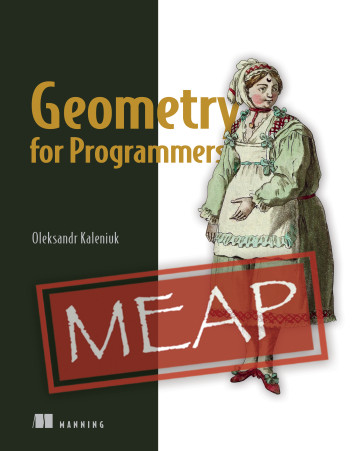 |
Here's the only ad you'll ever see on this site. I wrote a book. It's called Geometry for Programmers and it is exactly what it says in the title. It's about splines, voxels, transformations, all in the context of efficient programming.
Here's why: why.html. |
|